After the Storm, a River Rewilded
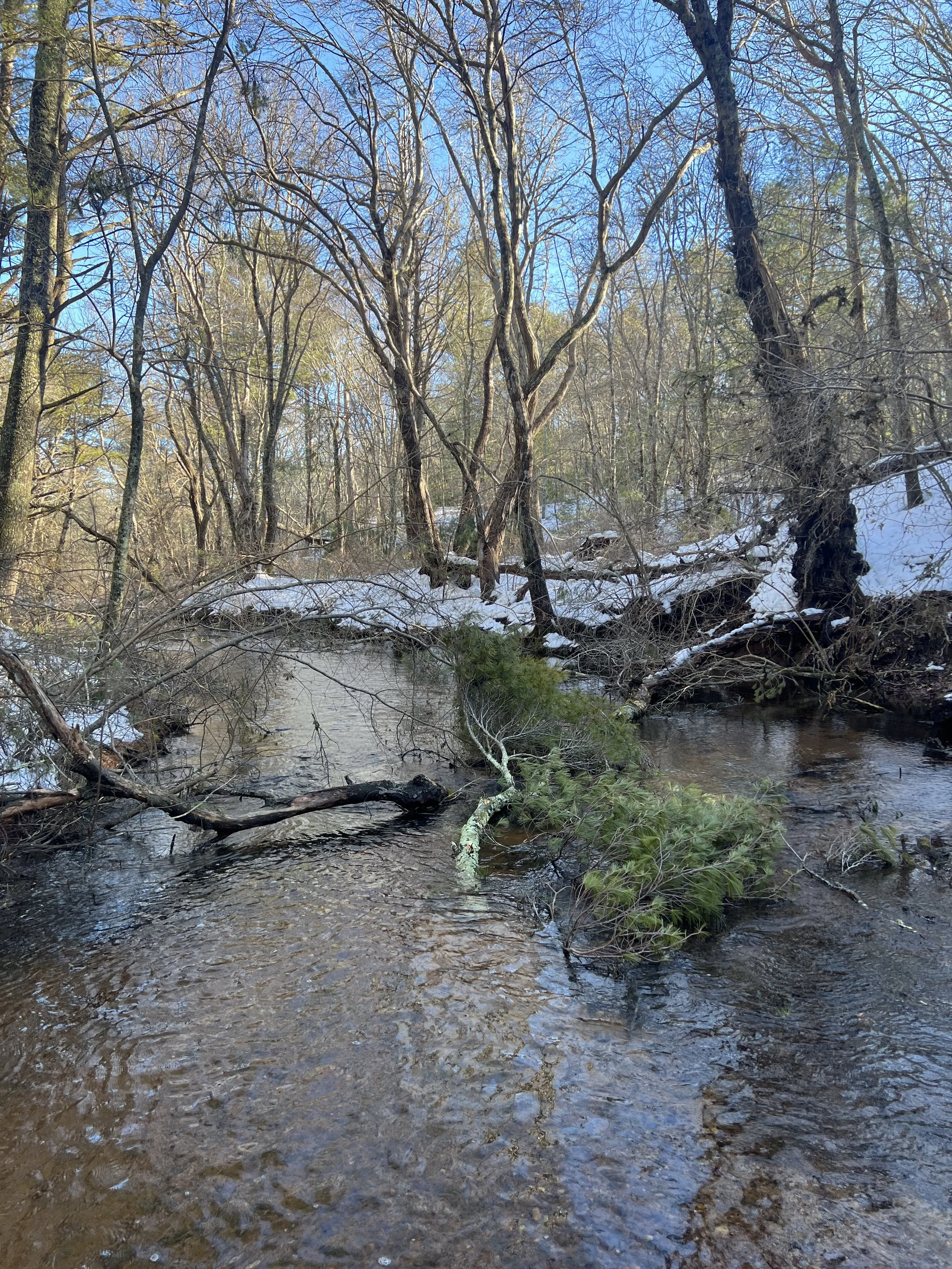
Freshly downed tree limbs spread across the Mashpee River in early March, 2026.
It only took one storm.
In late February, the Blizzard of ’26 swept across Cape Cod with enough weight and wind to do more than cover the landscape. Heavy, wet snow bent the woods low. Trees gave way. And along the Mashpee River, something shifted.
When the storm passed, the river did not look the same.
It had been rearranged.
The change is immediate. Along stretches of the Mashpee where the channel once ran clean and familiar, water now twists around fallen trunks and exposed rootwads. Flow that used to glide uninterrupted is forced to turn, split, and fold back on itself. In places, it disappears beneath fresh tangles of limbs and reemerges in unexpected seams.
Old holes are gone—or fractured by large wood dropped squarely into the current.
The river feels stripped of memory.
And yet, nothing about it feels diminished.
What looks, at first glance, like damage is something else entirely. The wood now scattered through the Mashpee River is not debris in the way it is often described. It is structure. It is the beginning of something more complex.
Large wood changes everything about how a river moves.
Flow slows where it meets resistance, then accelerates where it is forced through narrow openings. Water scours deeper beneath submerged trunks and root masses, carving out new pools. Sediment settles in quieter margins, building bars and soft edges. Channels divide and reconnect. Pockets of stillness form behind wood, offering refuge from the force of the current.
What appears chaotic is, in fact, the river beginning to organize itself in a new way.
Below the surface, this matters.
Fish moving through the Mashpee River—holding in cool groundwater-fed reaches or migrating between pond and bay—respond quickly to structure. They seek out places where energy can be conserved, where cover offers protection, and where food is delivered by the current but risk is reduced. The tangled wood, the newly split channels, the darkened water beneath rootwads—these are not obstacles. They are opportunity.
The previous holes may be gone, but new ones are already taking shape.
What had once been a familiar sequence of runs and pools has been broken into a mosaic of microterritories—small, varied habitats layered across the channel. Some are temporary. Others will deepen and persist. All of them are part of a system in motion.
Given time, the Mashpee River will continue to work this material. Flows will carve around lodged trees, deepening some areas while filling others. Organic matter will accumulate. Gravel will shift. The wood delivered by the storm will settle into place, becoming part of the architecture of the channel.
This is not disorder. It is process.
The Mashpee River is often seen as a steady, familiar system—flowing quietly from Mashpee and Wakeby Ponds toward Popponesset Bay. But it is anything but static. It is shaped by disturbance, by the constant interplay between water, sediment, and wood. Storms like the Blizzard of ’26 do not interrupt that process. They define it.
What remains in the wake of the storm is something rougher, less predictable, and more alive. The clean lines have been replaced by edges and shadows. The known has been replaced by the possible. The river no longer presents itself as something easily read, but as something to be understood again.
A river rewilded.
In time, the sharpness of it all will ease.
The raw edges of freshly fallen wood will soften under water and weather. Spring clean-up crews will head out to clear clogs and open passage for migrating river herring. Fishermen will break trail through downed branches and relearn their way along the banks. High water, sun, and seasons of flow will continue the slow work of settling what the storm set loose.
And the river will change again.
What feels abrupt now will, little by little, be absorbed into the life of the channel. Some of the new wood will hold fast and become lasting structure. Some will shift downstream. Some will trap leaves, gravel, and sand and begin shaping pools and shelter that were not there before. Time will soften the edges, but it will not erase what happened here.
The Mashpee River has already been rewritten.
What the Blizzard of ’26 left behind is not just disorder, but possibility—a rougher, more complex river, briefly stripped of familiarity and opened again to change.
For now, it runs wilder than it did before.
And for the life moving through it, that may prove to be exactly what it needed.